Melbourne reception problems come from a short list of causes, and where you live narrows that list faster than any amount of fiddling with the television. A house in the hills, a unit in the CBD and a weatherboard in Frankston fail in different ways for different reasons, and the fix follows the cause rather than the symptom.
This is the long version: where the signal actually comes from, why some parts of Melbourne are genuinely hard, how to read what your picture is doing, and what to do when the answer is that your address cannot receive a decent signal at all.
The short answer
- Almost all of Melbourne is served from one main transmission site, and your antenna has to be pointed at it.
- In the ranges, terrain blocks that path, which is why local repeaters exist.
- In the inner city the problem is usually reflections rather than weakness.
- Most suburban faults are not the antenna at all. They are the cable, the connectors or an amplifier.
- A genuine blackspot has a formal answer: satellite, assessed by address.
Where Melbourne's signal comes from
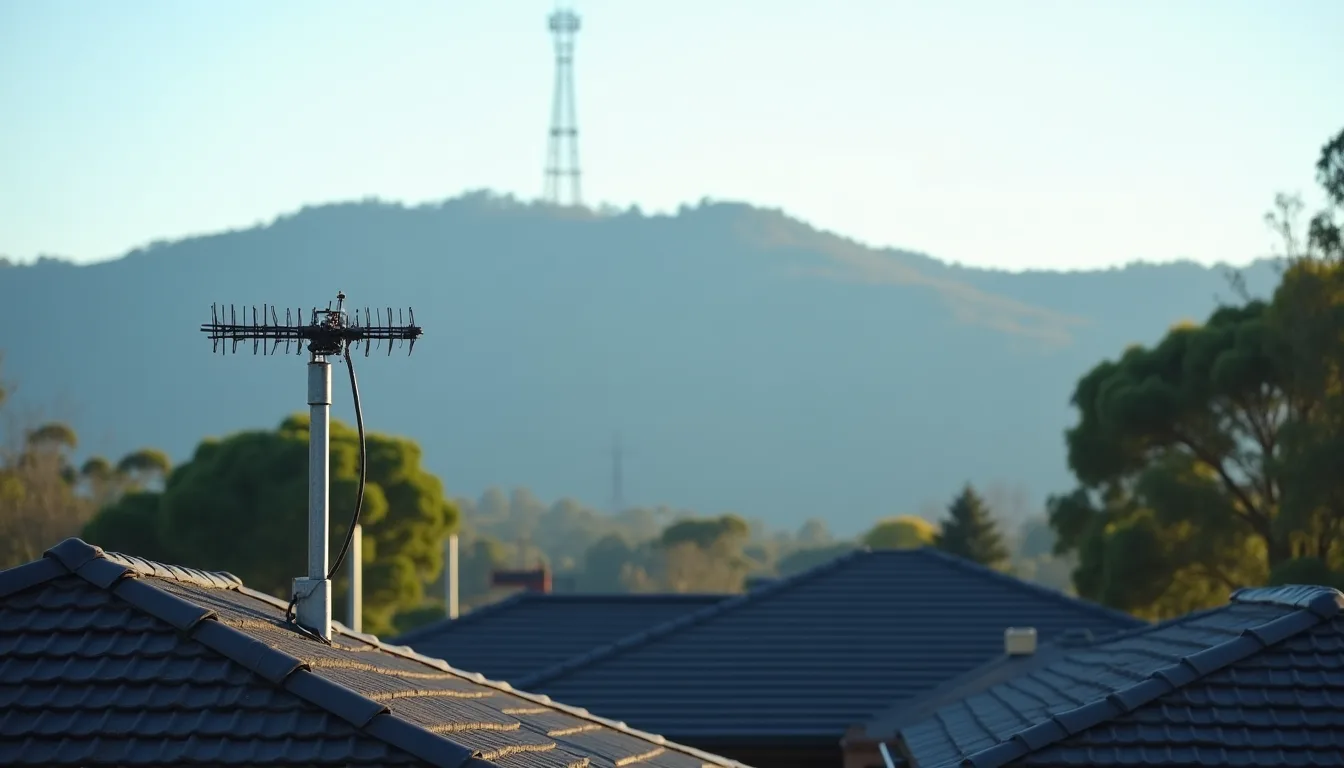
Free-to-air television reaches you from a transmitter, not from the internet, and in Melbourne that means one dominant site. The ACMA's 2022 household TV antenna survey for Victoria describes the towers on top of Mount Dandenong collectively as the main Melbourne site, and notes that inner-city households receive their reception from it.
Two things follow from that, and they explain a great deal of what we see on callouts.
The first is that direction matters more than size. An antenna is directional, and one aimed thirty degrees off the transmitter is throwing away signal it could have had for free. When a neighbour's antenna points visibly differently to yours, one of you is wrong.
The second is that not everyone is served by the main site. The ACMA's find a broadcaster or transmitter tool will tell you which transmitters serve an address, and it is worth knowing before anybody climbs on the roof.
Why the ranges are their own problem
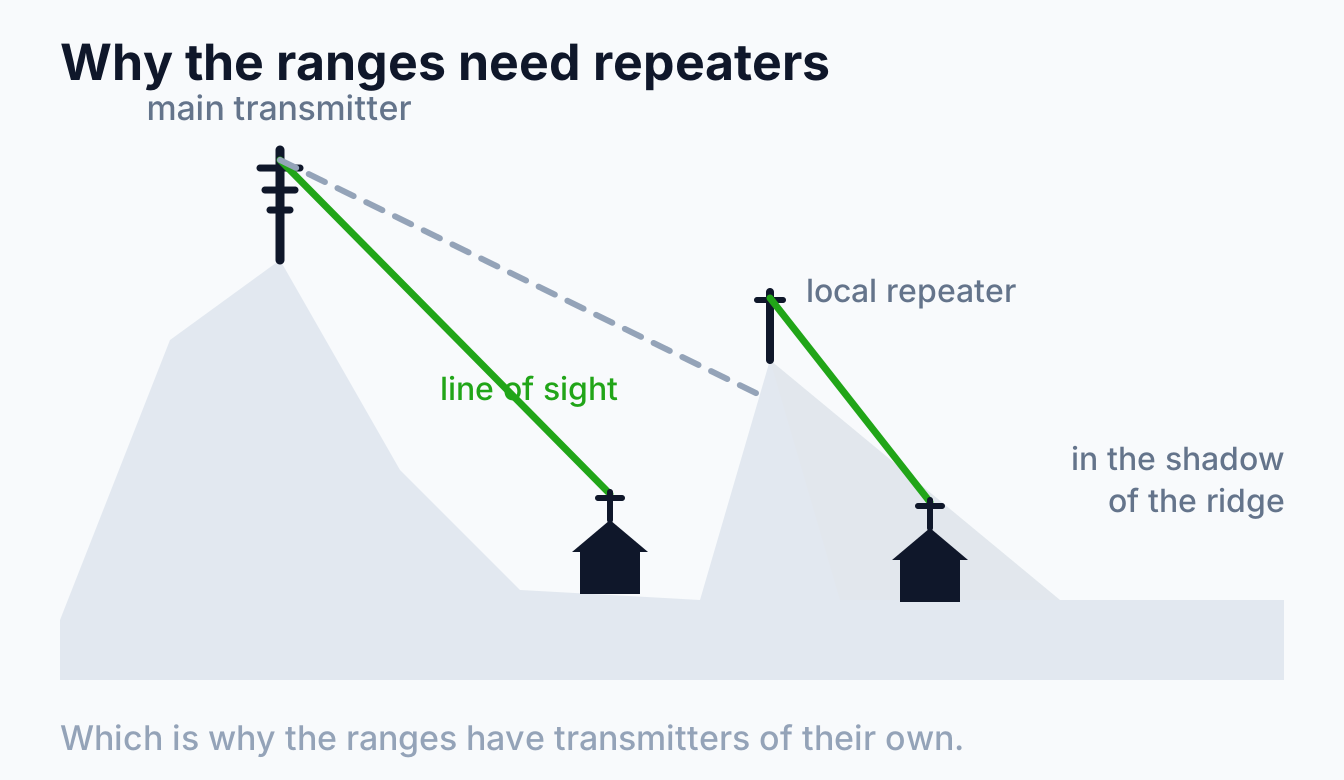
Hills do not weaken a signal so much as stop it. Radio at these frequencies travels in something close to a straight line, so a ridge between you and the transmitter leaves a shadow behind it, and no antenna on your roof can see through rock.
The regulator's own survey shows how that plays out here. Alongside the main site, it lists four repeaters at the bottom of Mount Dandenong (Ferntree Gully, Upwey, Selby and Monbulk) named after the areas they were planned to serve. Those exist precisely because the households below and behind the mountain cannot reliably see the towers on top of it.
For a homeowner in those areas the practical consequences are specific. Your antenna may need to point at a repeater rather than at the main site, and repeaters do not necessarily carry the same channels on the same frequencies as the main transmitter, so a television tuned by guesswork can end up locked onto a weak version of a service it should be receiving strongly from somewhere else. A manual retune with the right frequencies, aimed at the right transmitter, fixes more houses in the hills than new hardware does.
The rest of Melbourne's difficult places
The inner city and the high-rise belt. Here the trouble is rarely a weak signal. It is the same broadcast arriving twice, once directly and once bounced off a tower, a fraction of a second apart. That is multipath, and it produces a picture that breaks into blocks while the meter still shows plenty of strength. More gain makes it worse. A directional antenna aimed to reject the reflection is the fix, and in a unit block that is a roof job rather than something you can solve in your own lounge, which we cover in our guide to antennas in apartments and units.
Down the bay and the Peninsula. Distance from the transmitter does what distance does: it leaves less margin. Systems that work perfectly for years start dropping out in bad weather, because there was never much headroom and the antenna has quietly aged. This is the part of Melbourne where antenna quality and mounting height genuinely earn their money, and where our guide to choosing a TV antenna is worth reading before buying anything.
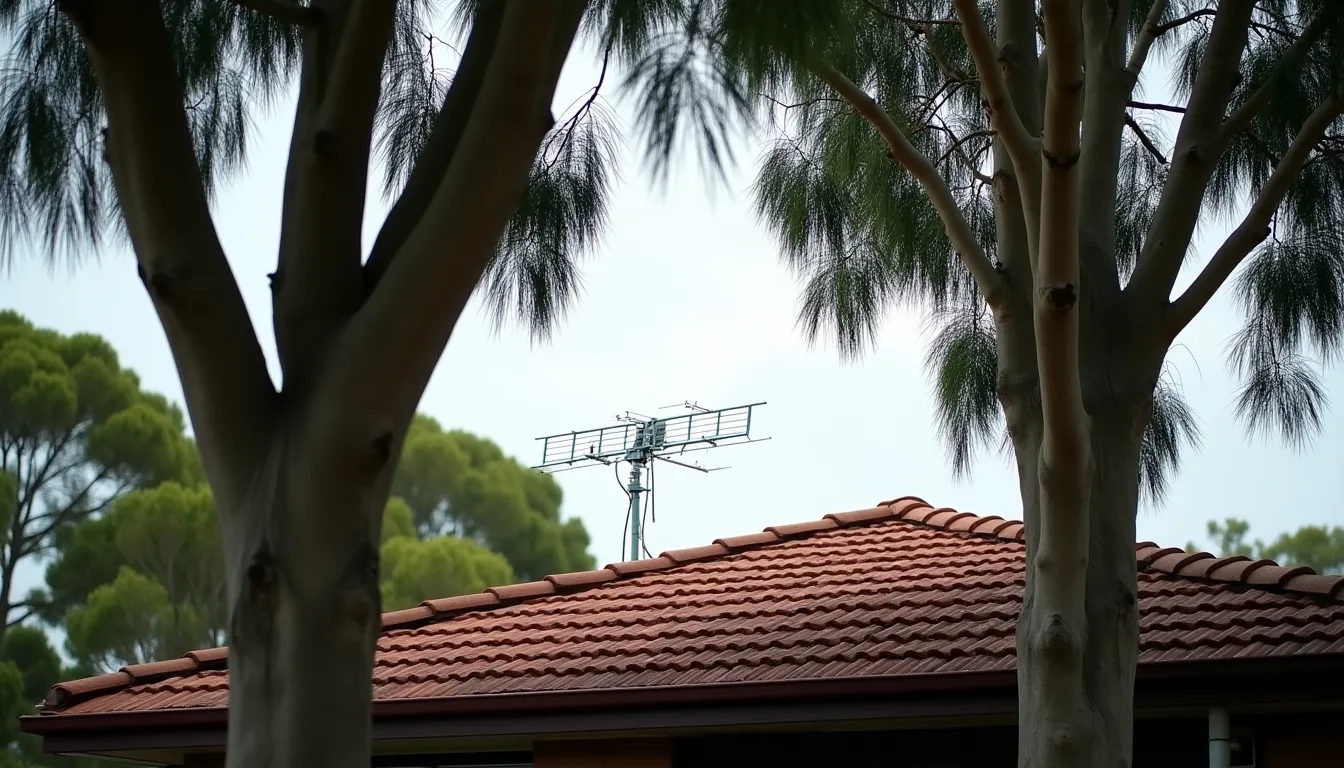
The leafy suburbs. Trees are the cause people most often refuse to believe, partly because the problem arrives so slowly. A eucalypt that was below the roofline when the antenna went up is above it fifteen years later, and wet foliage absorbs signal far more than dry foliage does, which is why so many households describe reception that is fine until it rains.
Valleys and gullies everywhere else. Melbourne is not flat, and a house sitting below a ridge in Warrandyte or Eltham has the same geometry problem as one in the hills, at a smaller scale. Height on the mast is the lever, and sometimes a metre is the difference.
Reading what your picture is doing
The way a picture fails narrows the cause considerably.
| What you see | What it usually means | Where to start |
|---|---|---|
| Blocky picture, sound cutting | Marginal signal or reflections | Antenna aim and height, then cabling |
| Some channels perfect, others unwatchable | A band or frequency problem, not a level problem | Antenna type and a manual retune |
| Every TV in the house lost signal at once | Something shared: the amplifier, its plug pack, or the antenna lead | The amplifier power supply first |
| One TV bad, the rest fine | Local to that room | That lead, that wall point, that tuner |
| Fine until it rains or the wind blows | No margin left in the system | Antenna condition, trees, connectors |
| Worse in the evening | Interference or an overloaded tuner | Amplifier gain and filtering |
Our two troubleshooting guides go through those patterns in detail: what to check when a TV says no signal, and why a picture breaks up or pixelates.
What actually fixes reception
Aim and height, before anything else. The cheapest real improvements are pointing the antenna correctly and getting it above the obstruction. Neither costs hardware.
The right antenna for the band you need. Melbourne services sit across two bands, and an antenna suited to one and pressed into service on both will show it. The choice depends on your address rather than on what is on the shelf.
Cable and connectors. Coaxial cable degrades, and the connectors go first, particularly outdoors, where water gets in and corrodes them. A tired run costs you more at the higher frequencies, which is why UHF services break up first as a system ages. Replacing cable is unglamorous and fixes a great many houses.
Filtering, where something else is getting in. Mobile transmissions in the neighbouring spectrum can overload a receiver, and a filter is a cheaper and more precise answer than more gain. The ACMA's guidance on reception and interference is the place to start if you suspect that.
Retuning, properly. Not the automatic scan run four times in a row, but a tune against the frequencies your actual transmitter uses. In the hills especially, this is the difference between locking onto the right service and the wrong one.
The full mechanics of why each of these matters are in our guide to what affects TV antenna reception in Melbourne.
What does not fix it
An amplifier, most of the time. It is the first thing people buy and the wrong answer more often than not, because it raises noise and reflections along with the signal, and in a strong-signal suburb it can overload the tuner outright. Amplifiers have a real job, overcoming losses across several outlets or a long run, which we set out in our guide to TV antenna amplifiers.
A bigger antenna, as a reflex. More elements help where the problem is weak signal on a clear path. Where the problem is a reflection or a ridge, a bigger antenna collects a stronger version of the same mess.
Repeating the automatic retune. If the scan finds nothing, running it again finds nothing again. Something upstream is not delivering, and that is what needs looking at.
When it really is a blackspot
Some addresses cannot receive a reliable terrestrial signal no matter what goes on the roof, and there is a formal answer for that rather than an expensive experiment.
Viewer Access Satellite Television delivers free-to-air services by satellite to households that cannot get adequate terrestrial reception. As the ACMA explains on its VAST satellite television page, the service exists for viewers in remote areas and in terrestrial digital television black spots, and access is assessed against an address rather than granted on request.
Before assuming you are in one, check what your address is predicted to receive. The mySwitch tool returns the expected reception and the transmitter serving a given address, and it is a useful reality check in both directions. It also catches the houses that should be receiving perfectly well and are not.
What we do on a callout
We start with a meter rather than a theory. Level and quality are two different numbers, and reading both at the wall point tells us in a few minutes whether the problem is weakness, interference or reflection, the distinction that decides everything else and the one guesswork cannot make.
From there it is a process of elimination that runs from the television back to the antenna: the lead, the wall point, the cable run, the amplifier and its power supply, the connectors at the mast, then the antenna itself and where it is pointed. Most jobs stop well before the roof.
Where the answer is genuinely the antenna, the replacement is chosen for the address (the band, the direction and the exposure) rather than from whatever is on the van. And where the honest answer is that the site cannot be fixed, we would rather say so than sell you a mast.
Frequently asked questions
Why is my reception worse when it rains?
Usually because there was very little margin to begin with. Wet foliage absorbs signal, water gets into tired connectors, and a system that was marginal on a dry day drops below the threshold on a wet one.
Everything worked until last week. What changed?
Look for something that changed physically: a new building, tree growth, work on the roof, or a plug pack that failed. Sudden whole-house losses are usually the amplifier's power supply rather than the antenna.
Do I need a new antenna every ten years?
Not on a schedule. Antennas fail from weather and corrosion rather than age alone, and a well-mounted one in a sheltered position lasts a long time. Coastal air shortens that considerably.
Can I aim the antenna myself?
You can improve it by matching the direction of well-performing neighbours, but fine aiming needs a meter. The best-looking picture and the strongest, cleanest signal are not always the same position, and a roof is not the place to experiment.
Would a taller mast fix it?
Often, and it is the most underrated fix we have. Getting the antenna above a roofline, a row of trees or a neighbour's extension changes what it can see, and a metre sometimes settles the whole argument. It has to be braced properly, though. A long mast on a light bracket is a wind problem waiting to happen.
Is streaming a way out of a bad reception area?
For a lot of households, yes. The broadcasters' apps carry the same channels over the internet, with the trade-offs we set out in do smart TVs still need an antenna.
Reception problems look mysterious and are usually not. There is a cause, it is measurable, and the geography of where you live rules most of the options in or out before anyone opens a toolbox. We work across Melbourne, the Mornington Peninsula and the south-eastern suburbs, and we will tell you plainly if your address is the problem rather than your equipment. Have a look at our TV antenna installation page, or book a free onsite quote and we will measure what is actually arriving.