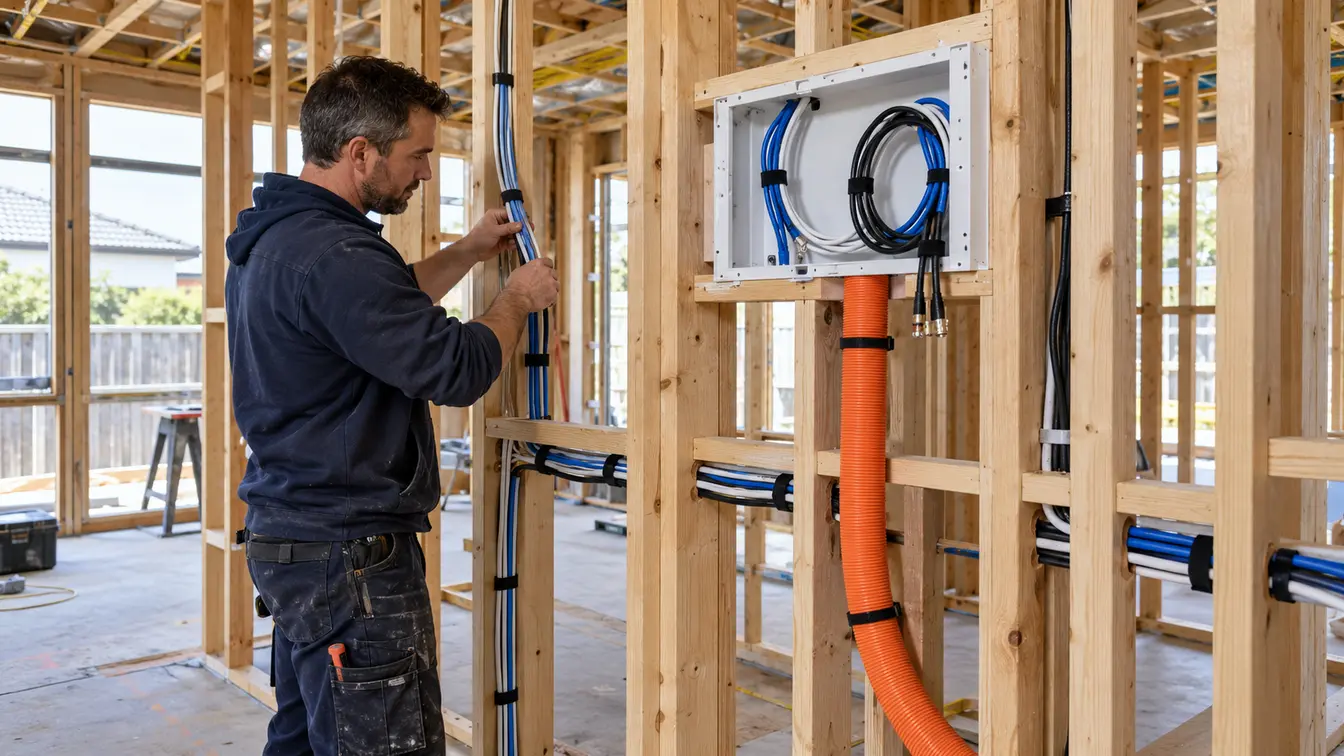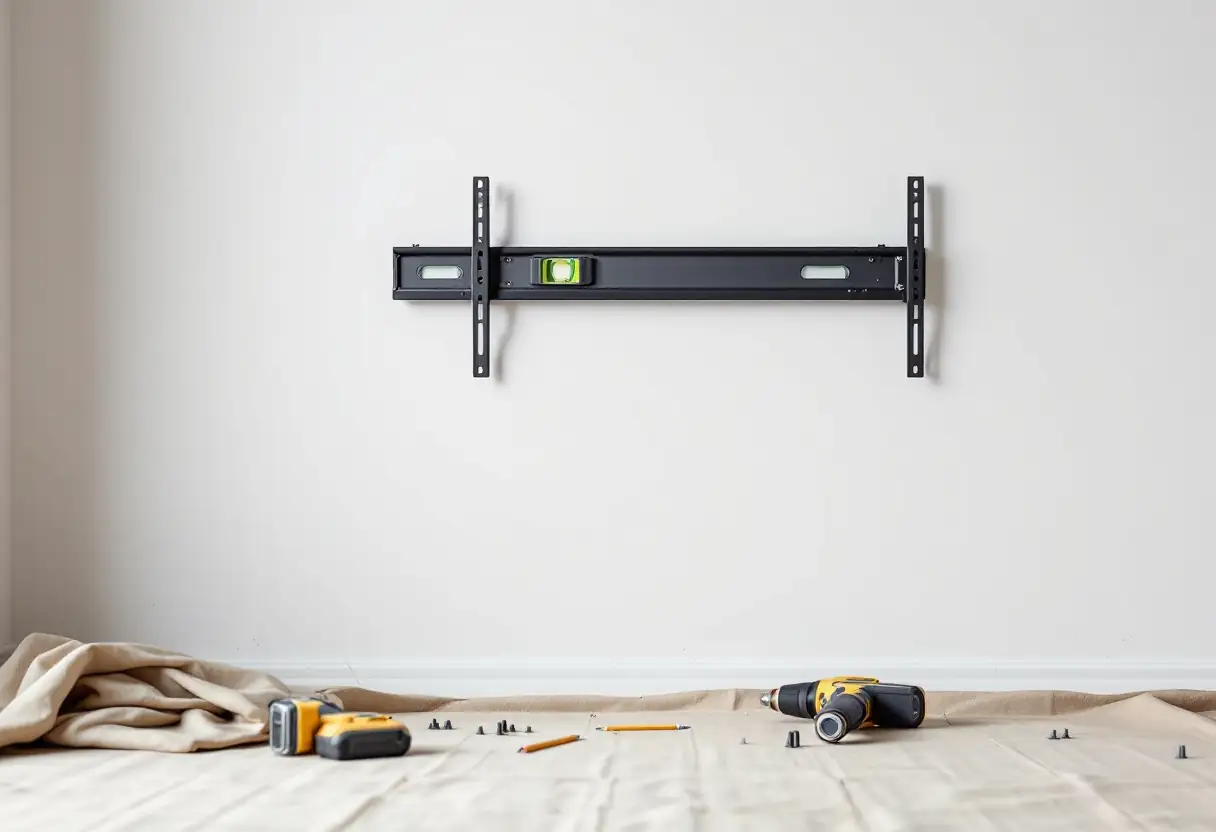
A bracket rated to 60kg, a television that weighs 25. That sounds like an enormous margin, and it is not a margin at all until you know what is behind the plaster.
The number on the box describes the bracket. It does not describe your wall, your fixings, or what happens when somebody swings the screen out to watch from the kitchen. Those are the things that actually decide whether it stays up.
The short answer
- The rating is the bracket's own strength, tested properly installed. It assumes everything behind it is sound.
- What holds your television is the weakest link in a chain: bracket, fixings, wall.
- Use your panel's mass from the manual, the figure without the stand, not the screen size.
- A full-motion arm extended can pull on the top fixings several times harder than the same television hanging flat.
- Leave real headroom. A rating you are sitting just underneath is not headroom.
What the number actually describes
A load rating is a statement about a piece of steel. It says that this bracket, assembled as the instructions describe and fixed to a structure capable of taking the load, will carry that much weight.
Read that last clause again, because it is the whole article. The rating is conditional on the wall, and the manufacturer has no idea what your wall is. They cannot rate it, so they assume it.
It is also a static figure. It describes a television hanging still, not a television being pushed, leaned on, pulled downward by somebody steadying themselves, or swung out on an arm. Real installations get all of those.
The chain, and where it usually breaks
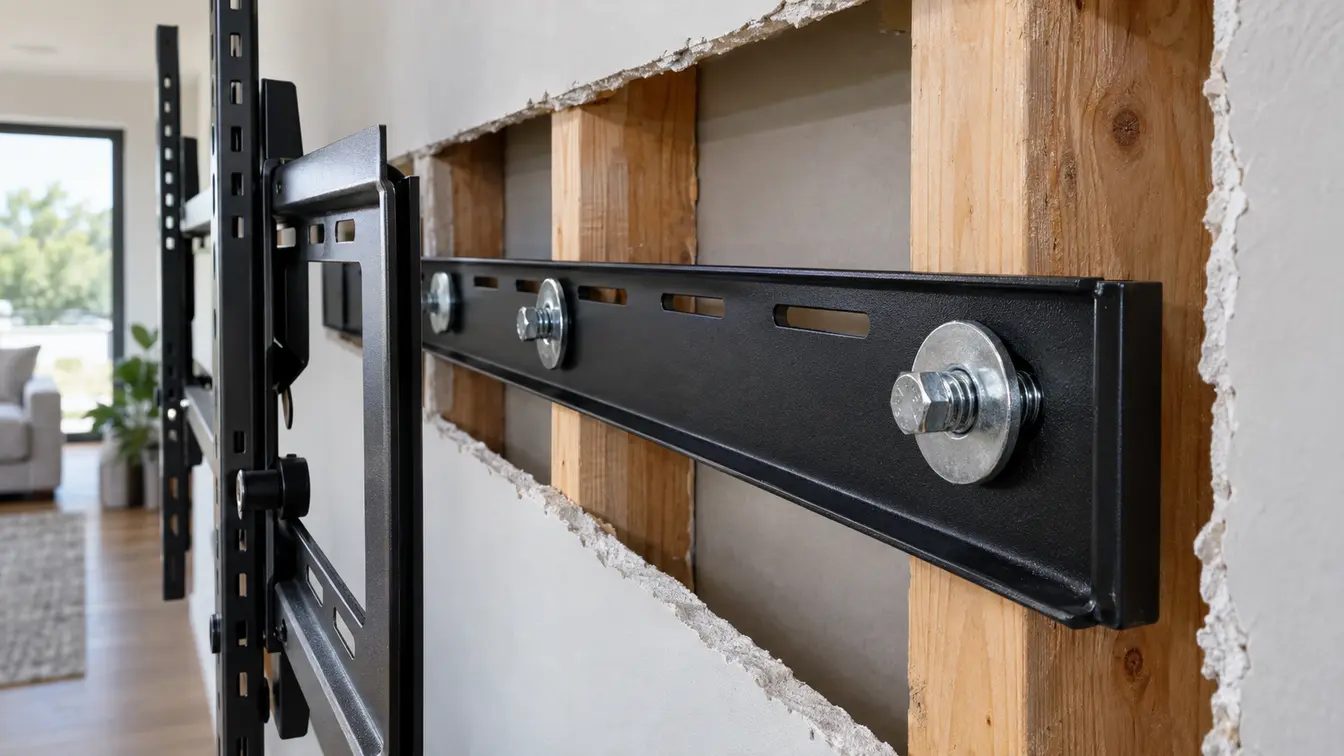
Three things carry the screen, and only one of them comes with a number printed on it.
The bracket. Rated, tested, and almost never the problem. Brackets themselves rarely fail.
The fixings. Chosen by whoever installed it. This is where a good bracket gets hung on the wrong screws, or on plasterboard anchors, and where most of the failures we are called out to actually start.
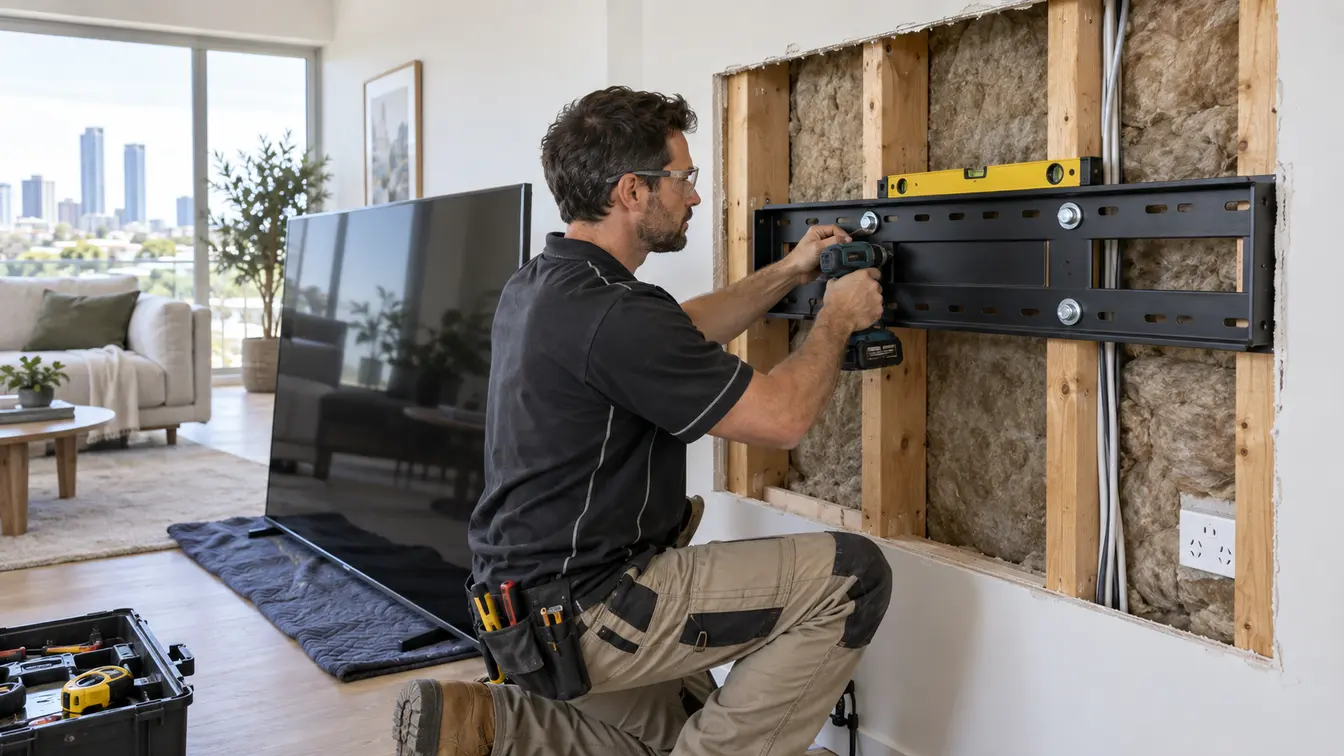
The wall. Whatever the house already had, decided decades ago by somebody who was not thinking about televisions. Timber studs at 450 or 600mm centres, steel studs, brick veneer, double brick, render over block, lightweight concrete. Each takes different fixings and each has a different honest limit.
The assembly is only ever as strong as the weakest of the three, and the wall is the link nobody checks. A 60kg bracket fixed into plasterboard with hollow wall anchors is not a 60kg installation. It is an anchor installation with a good bracket attached to it, and we go through why that matters in mounting on plasterboard. On masonry the questions are different and the limits are mostly generous, which we cover in brick, concrete and rendered walls.
Finding your television's real weight
Use the mass in the manual or on the manufacturer's specification page, and use the figure quoted without the stand. That is the number that ends up on the wall. The with-stand figure is usually several kilograms higher and is not what you are hanging.
Screen size is a poor proxy. Two panels of the same size from different makers can differ substantially, and panel technology moves the number around more than inches do. Our guide to VESA patterns and bracket fit covers the rest of the fitment side, including why a matching hole pattern tells you nothing about load.
Leverage, which is the part people underestimate
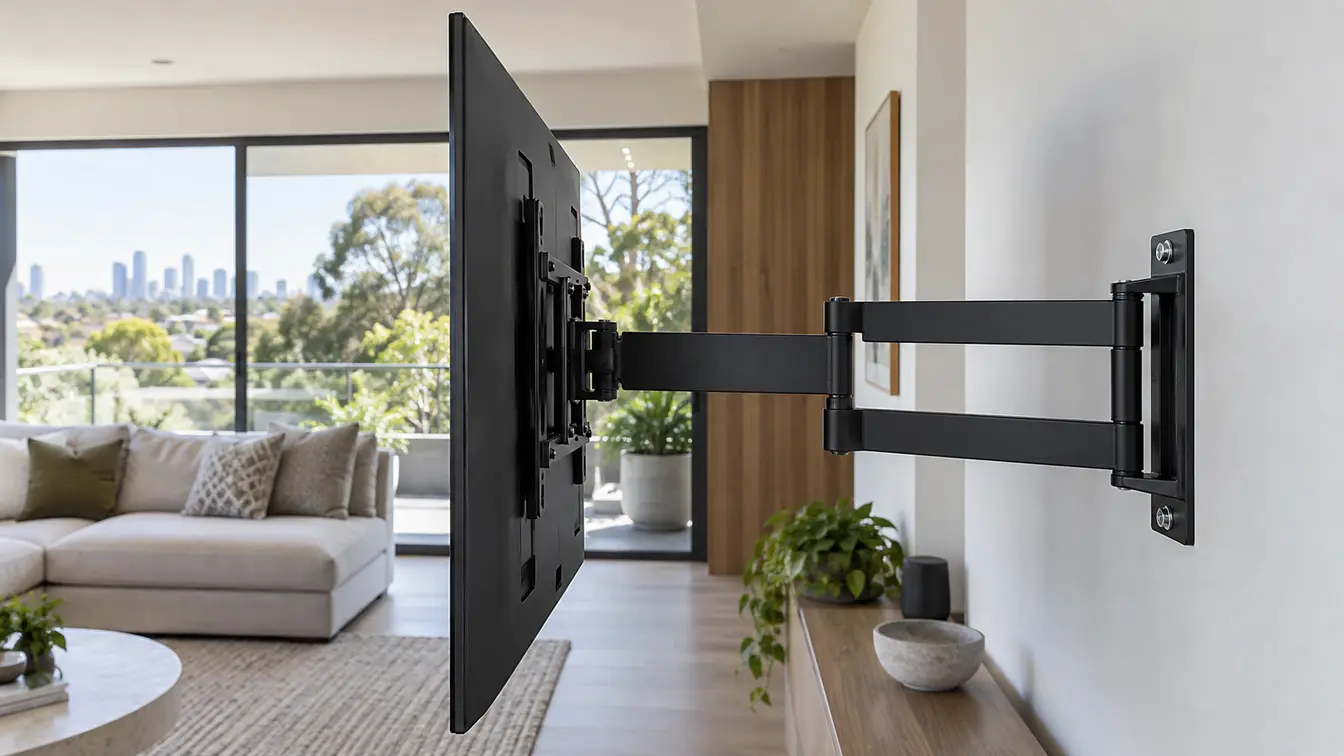
Hanging flat against the wall, a television mostly pulls downward. Swing it out on an arm and the physics changes, because the weight is now acting at the end of a lever.
The bracket plate resists that by pulling in at the top and pushing in at the bottom. So the further the screen travels from the wall, the harder the top fixings are pulled straight out of it. The weight of the television never changes. What it is doing to your wall does.
Here is that arithmetic for a 25kg panel, on a wall plate with its top and bottom fixings about 300mm apart. The numbers are an illustration rather than a specification, but the shape of them holds for any bracket.
| Position of the screen | Pull-out force at the top fixings |
|---|---|
| Folded flat, about 60mm off the wall | roughly 5kg |
| Extended about 500mm from the wall | roughly 42kg |
Eight times the load, from the same television, because somebody pulled it out to watch the football from the kitchen. That is why a full-motion mount on a single stud is a different proposition from a fixed one, and why we compare the types in fixed, tilt and full-motion mounts.
The loads nobody rates for
A rating assumes a television hanging quietly. Households are not like that.
Somebody steadies themselves on the screen getting off the couch. A child hangs off the bottom edge. A vacuum cleaner catches the cable. Someone pushes the panel flat against the wall to get past it and puts their weight through the arm. None of that is in the test.
It is also the reason the ACCC treats televisions as a serious household hazard, and its guidance on toppling furniture and televisions is aimed squarely at homes with small children. A properly mounted screen is one of the better answers to that problem, and we compare it against a stand in TV stand versus wall mount. Properly mounted is doing the work in that sentence.
How much headroom is enough
There is no rule, and anyone offering you a precise multiplier is inventing it. What we do in practice is straightforward.
Choose the bracket for the wall, then check it against the panel. Not the other way round. The wall is the constraint you cannot change.
Do not sit just under the number. A 30kg television on a bracket rated to 32kg leaves nothing for the day somebody leans on it. Comfortably above is not extravagance, it is the point.
Rate the fixings, not just the bracket. Into timber that means proper coach screws with real depth past the plasterboard. Into masonry it means anchors made for that material, at the size the bracket specifies.
Spread the load when the wall will not cooperate. A backing plate across several studs turns an awkward wall into a straightforward one, which is often the answer on larger panels, as we cover in mounting a 75, 85 or 98 inch TV.
Frequently asked questions
How much weight can a TV wall mount hold?
Whatever the weakest of three things allows: the bracket's rating, the fixings used, and the wall behind them. The bracket's number is the best case, and only if the other two are right. On plasterboard without reaching the framing, the honest answer is almost nothing.
Is my TV's weight on the box?
Usually, but check which figure it is. You want the mass without the stand, which is what the manual and the manufacturer's specification page quote. Screen size is not a reliable guide, because panels of the same size vary.
Do I need a bracket rated much higher than my TV?
Comfortably higher, yes, though there is no magic multiplier. The headroom covers the loads no rating includes: somebody leaning on it, a child pulling on it, a knock while cleaning. Sitting just under the rating leaves nothing for any of that.
Why do full-motion mounts need a stronger wall?
Because extending the arm turns the television into a lever. The weight stays the same but the pull-out force on the top fixings multiplies with distance from the wall, and it can easily reach several times the panel's mass.
Can a bracket be too strong for my TV?
No, and a heavier duty bracket is often the better buy. The only costs are money, a little more depth off the wall on some models, and slightly more weight to handle during the install.
My TV has been up for years. Should I check it?
Worth a look once a year, particularly on a full-motion arm that gets moved. Check the bracket bolts are still tight and that nothing has moved at the wall. Anything that has started to sag has usually been telling you for a while.
A weight limit is the beginning of the question rather than the answer to it. Find your panel's real mass, work out what the wall can honestly carry, pick fixings that suit it, and leave room for the day somebody leans on the thing. We check what is behind the plaster before we quote rather than on the day, and we would rather tell you a wall needs a backing plate than find out afterwards. Have a look at our TV wall mounting page, or book a free onsite quote.