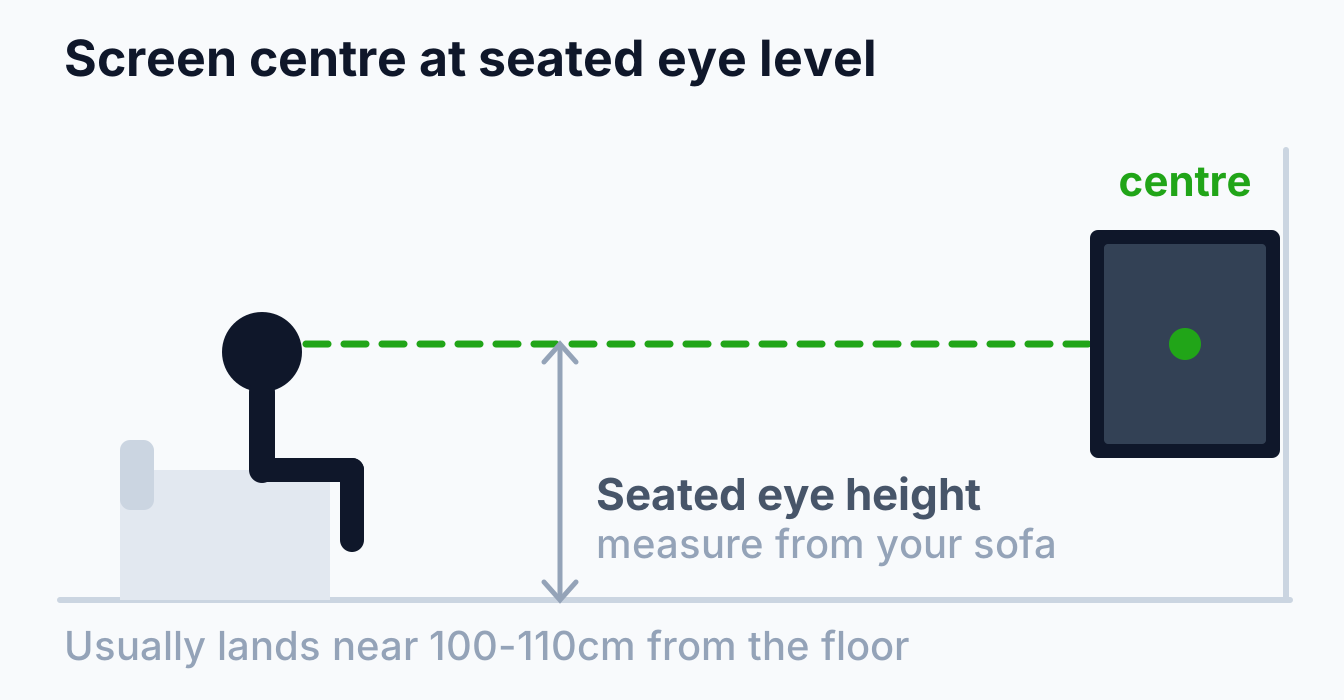
The centre of the screen wants to sit at your eye level when you are sitting down. On a standard sofa that usually lands somewhere near 100 to 110cm from the floor, which is lower than almost everyone expects.
That number is a sanity check, not the answer. The answer comes from your sofa, your screen and where you actually sit, and it takes about five minutes to work out. Here is the method, the trap that catches people at the drilling stage, and what changes in a bedroom, a kitchen or above a fireplace.
Why it is about your sofa, not the room
Almost every TV mounted too high was mounted by someone standing up. You hold the screen against the wall, step back, and it looks right, because your eyes are at about 160cm and the TV is where a picture would hang. Then everyone sits down, and it is 40cm too high for the next five years.
Screens are also lit and angled for straight-on viewing. Look up at one and you lose contrast, the colours shift, and reflections off the ceiling land in the picture. The discomfort is not just your neck.
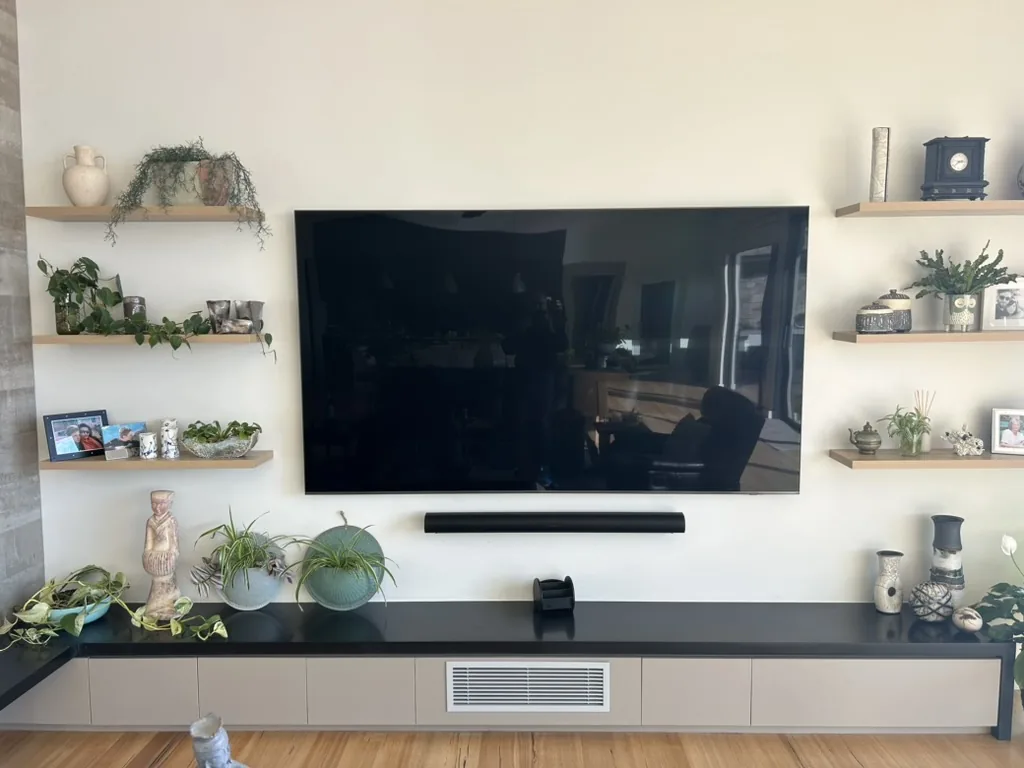
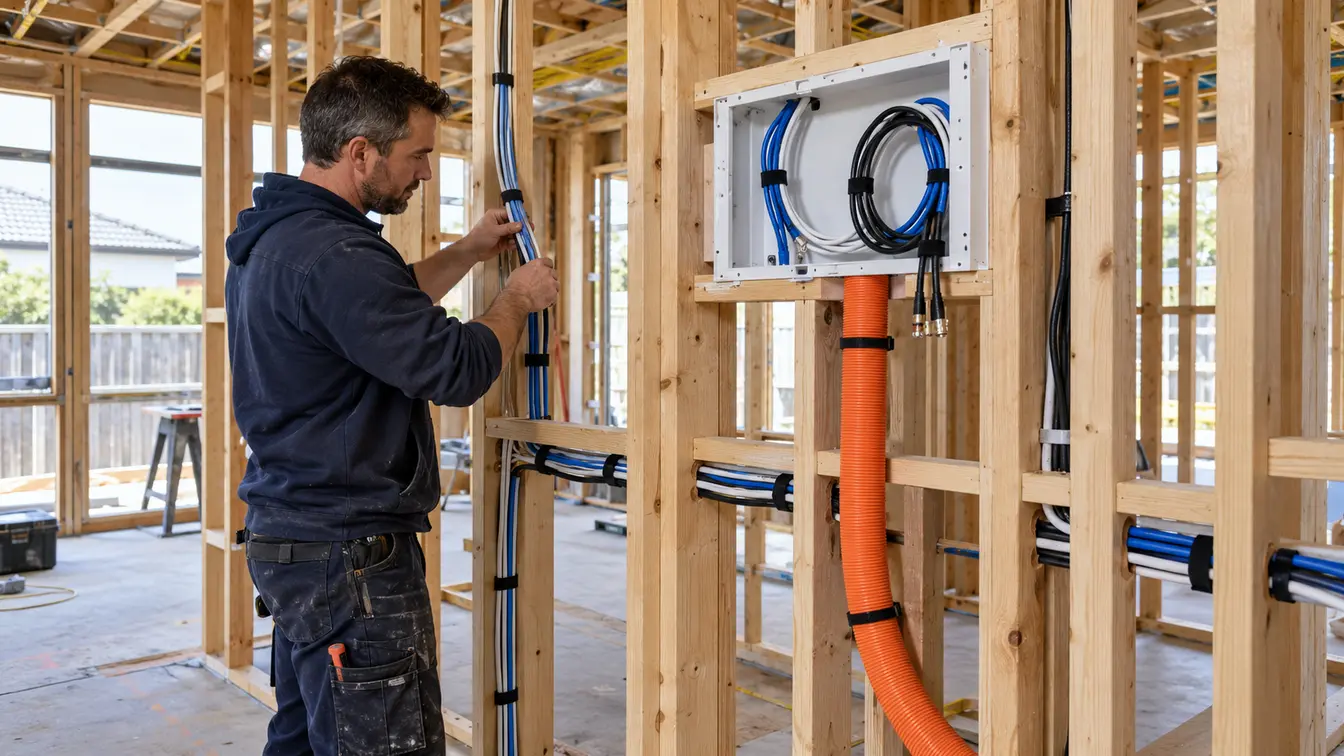
The picture above is the height we aim for. The screen sits low over the console, the soundbar has clear air beneath it, and nobody in that room is looking up.
Working out your number
Four steps, a tape measure and a helper.
- Sit where you actually watch from. Not the armchair nobody uses. Measure from the floor to the centre of your eyes. Most people land between about 100 and 120cm depending on the sofa. A deep, soft lounge puts you lower than a firm upright one.
- Measure the screen height. The height of the panel itself, not the diagonal the box quotes. A 65-inch screen is roughly 81cm tall, so half of it is about 40cm.
- Put the screen centre at your eye height. If your seated eye height is 105cm, the centre of the screen goes at 105cm, and the top of that 65-inch panel ends up around 145cm.
- Check it before you drill. Cut cardboard to the screen size, have someone hold it there, and sit down. Two minutes of that saves years of regret.
If the number feels low, that is normal. It looks low while you are standing in front of it and correct the moment you sit.
The bracket is not the screen centre
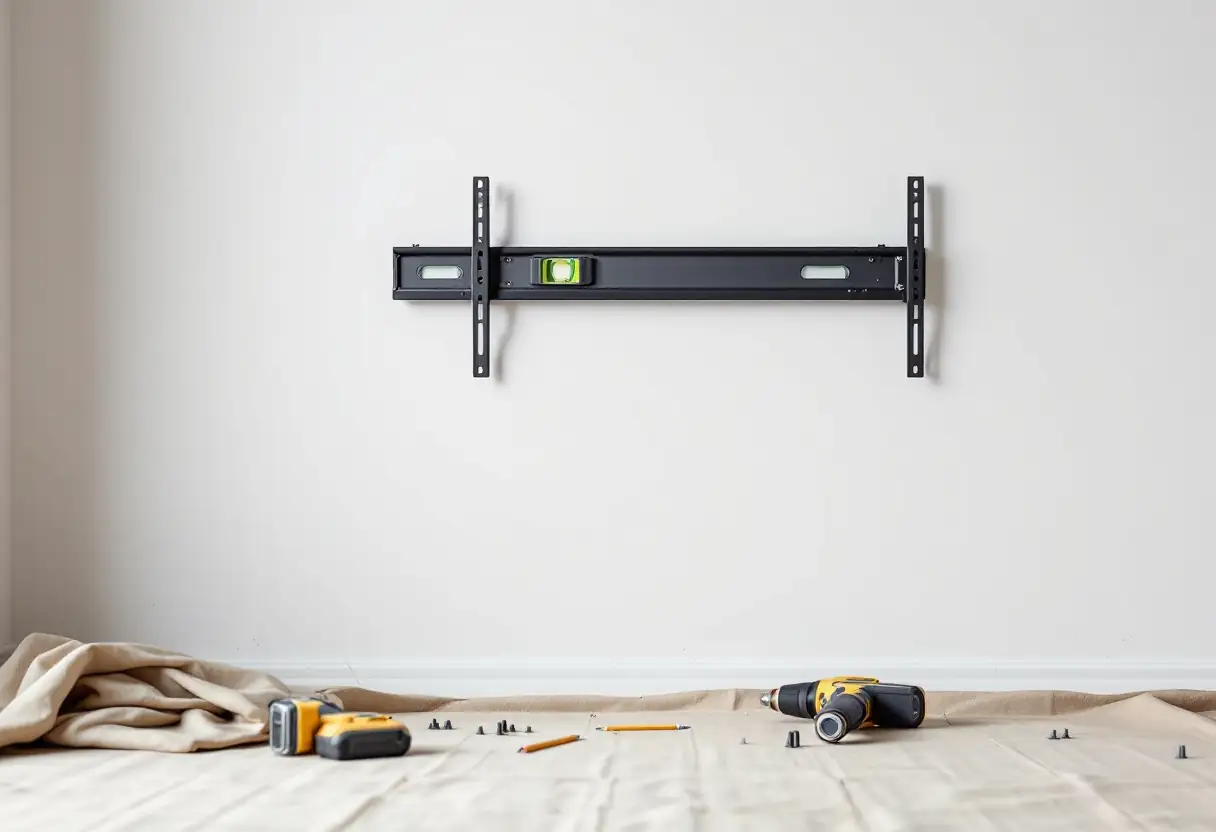
This is where a carefully measured job still goes wrong. You now know where the centre of the screen belongs, but you do not drill at the centre of the screen. You drill where the bracket's wall plate goes, and on most TVs the mounting holes are not in the middle of the back.
Those holes follow the VESA pattern, a standard set of fixing points on the back of the panel. The VESA flat display mounting interface covers screens from 31 to 90 inches and loads up to 113.6kg in its largest part, which is most of what goes on a domestic wall. On a lot of larger panels that pattern sits above the vertical centre, so hanging the bracket at your target height puts the screen lower than you intended.
The fix is simple. Before drilling, hold the bracket against the back of the TV and measure from the top edge of the panel down to the bracket's hanging point. Transfer that same distance down from where the top of the screen needs to be. Work from the top edge rather than the centre and the arithmetic stops betraying you.
Full-motion brackets add another wrinkle, because the arm lifts the screen slightly as it extends. Worth a test hang before the final fix.
What changes room by room
The seated-eye-level rule holds everywhere. What changes is where you are sitting, and how upright.
| Room | How you watch | What that means |
|---|---|---|
| Lounge | Upright on a sofa | The standard case. Centre near 100 to 110cm |
| Bedroom | Propped up or lying down | Higher than a lounge, and a tilting bracket earns its place |
| Open-plan kitchen | Standing and sitting, from several spots | A compromise height, or full-motion so it can be aimed |
| Study or office | Upright at a desk | Lower again, and closer than people expect |
| Home gym | Standing, moving | Higher on purpose, with tilt to bring the angle back |
The bedroom is the one people get most wrong in the other direction. If you watch propped against the bedhead, your eye line is well above where it would be on a sofa, and a screen set at lounge height ends up too low. Measure from the bed, in the position you actually lie in.
Where you genuinely watch from more than one place, the honest answer is a bracket that moves. We go through the trade-offs in our comparison of fixed, tilt and full-motion brackets.
Above the fireplace
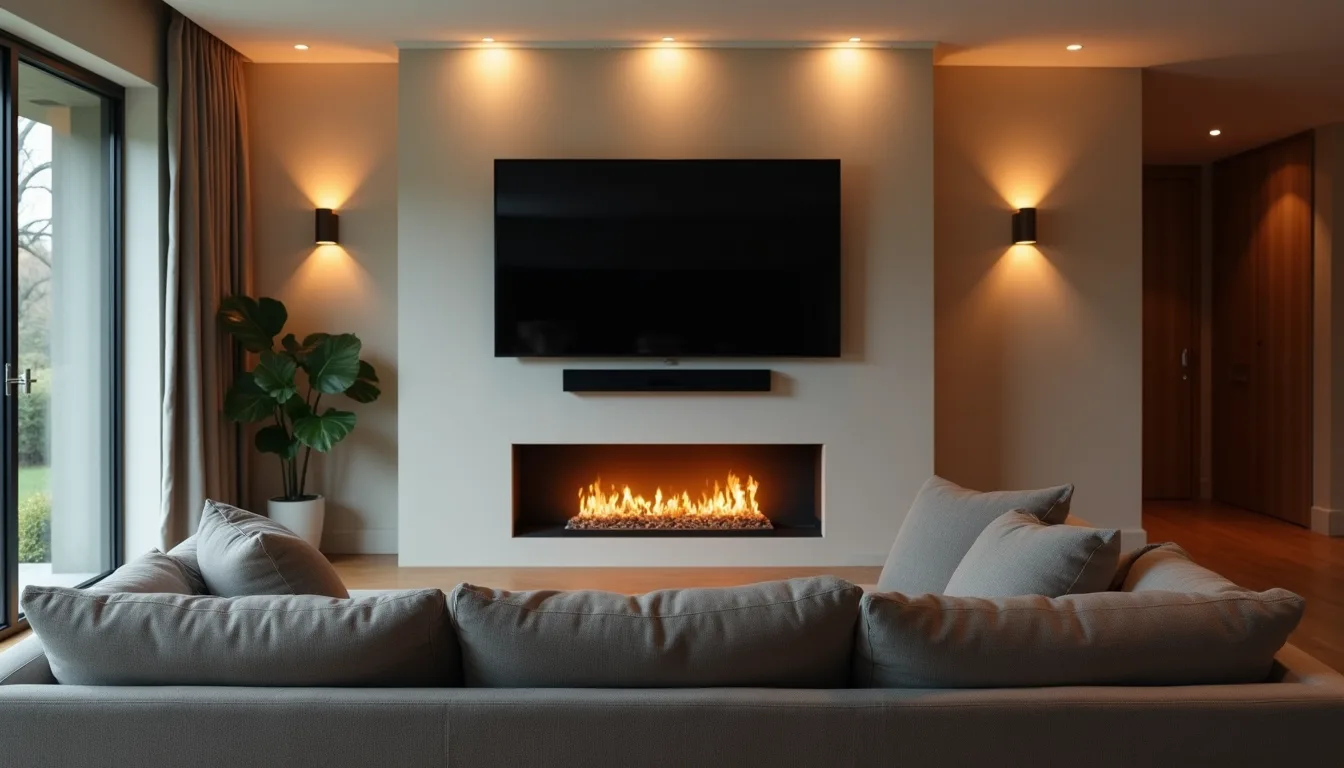
It looks like the photograph above, and the photograph is exactly the problem: that screen is a long way above anyone sitting on that sofa.
Sometimes the room leaves no choice. The chimney breast is the only wall, or the joinery is built around it. If that is where it has to go, tilt the screen down and accept the compromise knowingly. Just be clear about what tilt does: it improves the angle you are looking at the panel from, and it changes the height not at all. You are still looking up.
Heat is the second consideration and it varies enormously. A sealed modern unit and a working wood fire are very different propositions for electronics sitting above them, so it is worth finding out how much your fireplace actually throws before committing. We go through the heat, the wall construction and how to measure your own fireplace in can you mount a TV above a fireplace.
Things that quietly change the height
A soundbar. If one is going underneath, it needs clear air beneath the screen or it blocks the bottom of the picture and the TV's own remote sensor. Decide on the soundbar before you set the height, not after, and our guide to mounting a soundbar under a wall-mounted TV covers the gap it needs.
A console or floating shelf. The screen should not look like it is sitting on the furniture. A gap of roughly a hand's width under the panel reads as deliberate; less than that looks like a mistake.
Screen size. Going bigger does not move the centre, it stays at your eye level, but it does push the top of the screen higher and the bottom lower. On a very large panel in a small room, check that the bottom edge still clears whatever is under it. What size the room can carry is a separate question, and we work through it in how far you should sit from a wall-mounted TV.
Where the studs are. Occasionally the ideal height falls awkwardly against the framing. That is solved with a backing plate spanning several studs rather than by moving the TV up, which is the compromise people tend to accept without realising they had a choice.
Frequently asked questions
How high should a 65-inch TV be mounted?
The same rule as any other size: centre at your seated eye level. For a 65-inch panel, which is roughly 81cm tall, a seated eye height of 105cm puts the bottom of the screen near 65cm and the top near 145cm.
Is there a standard height I can just use?
Around 100 to 110cm to the centre suits most lounge rooms, and it is a reasonable starting point if measuring is impractical. It is a starting point though. Sofas and people vary more than the rule of thumb allows for.
Can the TV be too low?
Yes, though it is far rarer. Too low usually shows up as the bottom of the screen being blocked by a coffee table or the console, or the picture being partly hidden by whoever is sitting in front. A screen slightly low is still more comfortable than one slightly high.
Does a tilting bracket mean the height matters less?
No, and this is the most common misunderstanding we hear. Tilt improves the viewing angle onto the panel. It does not lower the screen, and it does not stop you looking upward.
Should I match the height of the TV in the showroom?
No. Retail displays are hung for people walking past them, which is why they sit at standing eye level. Copying that height at home is one of the more reliable ways to end up too high.
Height is the cheapest thing to get right and among the most annoying to live with when it is wrong, because fixing it later means new holes in a wall you have already patched once. We set it from where you actually sit before anything is drilled, which is why it comes second in our home theatre setup checklist. Have a look at our TV wall mounting page, or book a free onsite quote and we will work it out in your room.