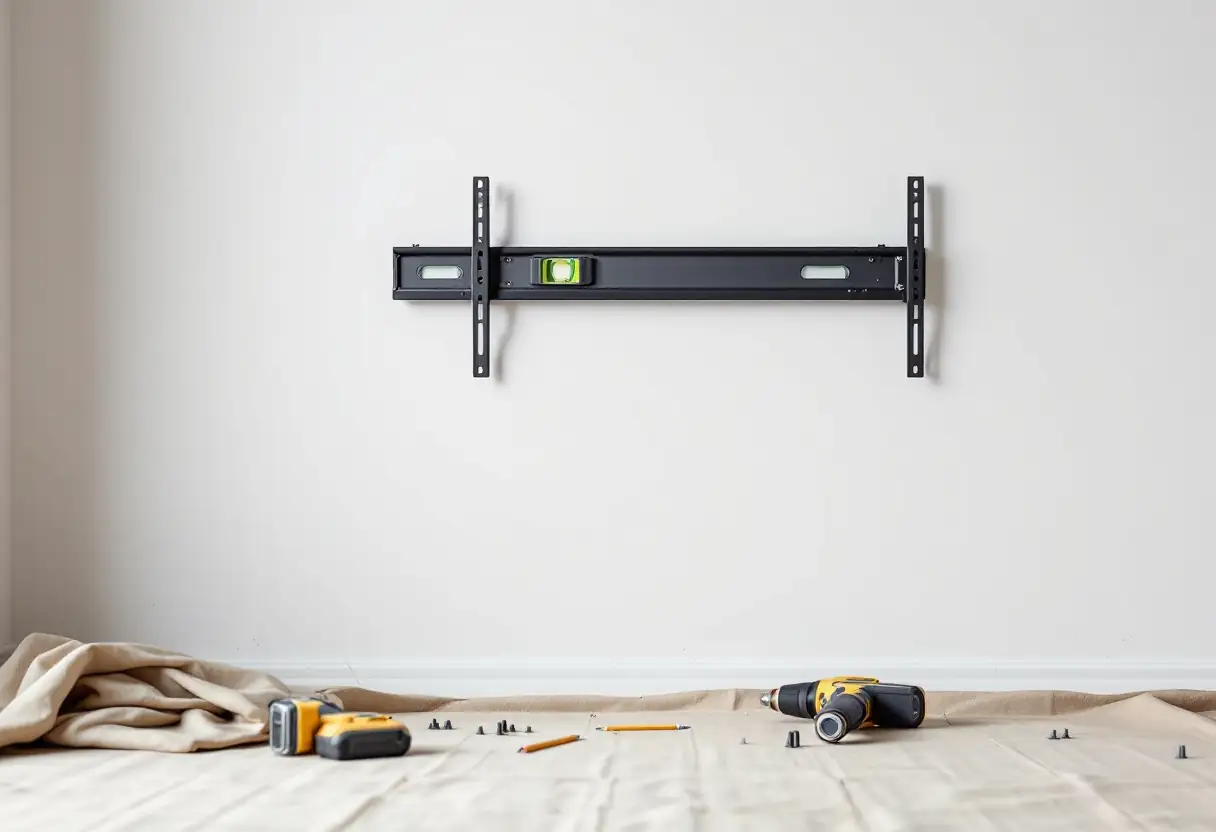
The bracket is the same shape. Almost nothing else is.
Mounting a screen in an office, a cafe or a shop looks like the residential job and behaves like a different trade. The wall is more likely to be steel or concrete than timber, some walls in the building are fire-rated and cannot be drilled freely, the screen has to be seen by people standing up, the television you were about to buy is not warranted for the use you have in mind, and the whole thing has to happen without shutting you down for a day.
The short answer
- A consumer television used in a business sits outside its manufacturer's warranty. Commercial displays exist for a reason.
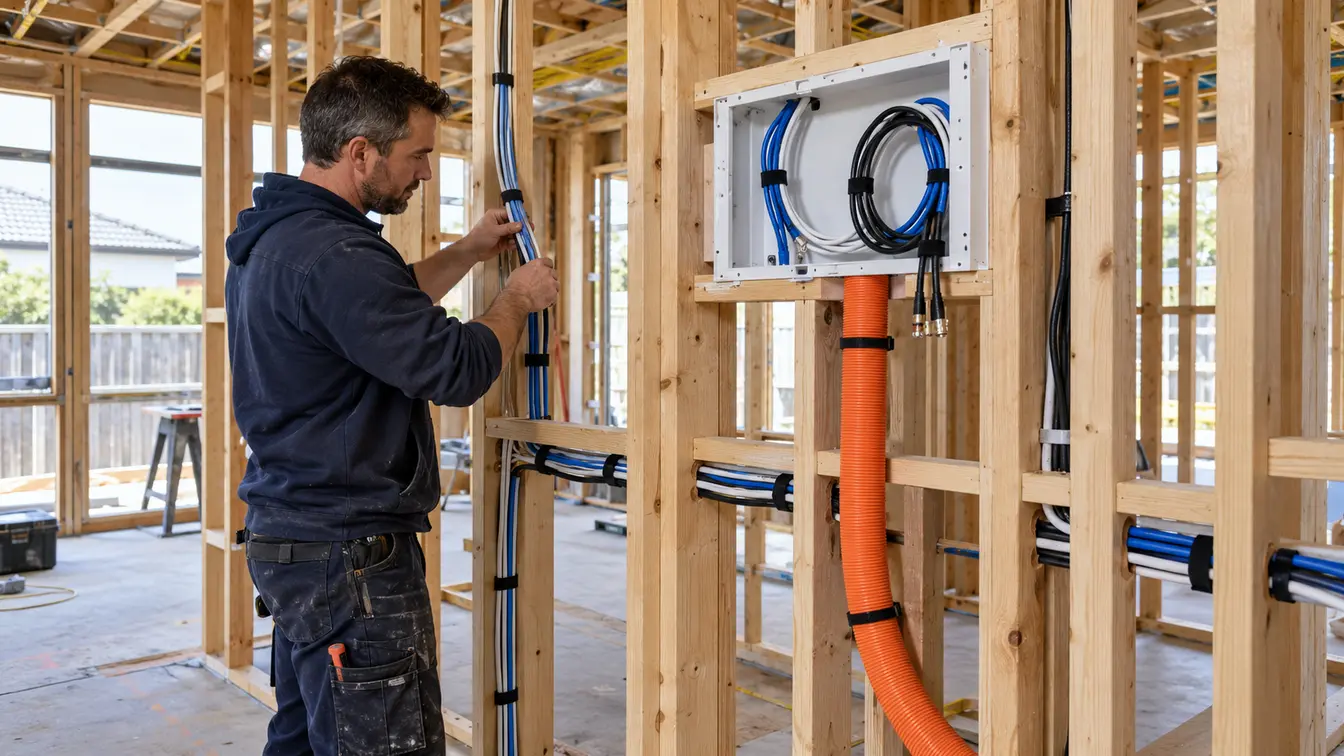
- Commercial walls hide different things: steel studs, building services, and fire-rated construction you may not penetrate freely.
- Height is set by the standing crowd, not by a seated eye line.
- Anything within public reach needs fixings and a bracket chosen with that in mind.
- Most of the cost difference is access and cabling, not the bracket.
What actually changes when it is a business
| A home | A commercial site | |
|---|---|---|
| The wall | Timber stud, brick veneer, plaster | Steel stud, concrete, sometimes fire-rated |
| The screen | A television, warranted for domestic use | A display rated for the hours it will run |
| Who watches | One settled seating position | Seated and standing, from several angles |
| Who can touch it | You | Staff on shift, and the public |
| When we can work | Any weekday | Often before opening or after close |
| What a failure costs | An evening | Trading, and possibly an incident |
| Paperwork | None | Insurance, site induction, sometimes building approval |
None of that makes it a harder job. It makes it a different one, and it is why a quote for a venue asks questions a quote for a lounge room does not.
The screen: a television or a commercial display
This is the part that costs businesses money, and almost nobody is told about it at the point of sale.
A consumer television is built, priced and warranted for domestic use. Samsung's Australian warranty terms define a consumer product as one used in a normal domestic environment, not a commercial environment. Other manufacturers word it differently and mean much the same thing. So the television in your cafe may be entirely outside its warranty from the day it goes up, which nobody discovers until it fails in month fourteen.
Your rights under Australian Consumer Law are separate and are not removed by a manufacturer's warranty terms. But a warranty claim and an ACL argument are very different amounts of work, and the second one starts with a conversation you would rather not be having during trade.
What a commercial display buys you is not picture quality. It is:
- A rated duty cycle. Panels specified for long daily hours rather than an evening's viewing.
- Portrait mounting. Consumer televisions vent heat assuming they are landscape. Turn one on its side for a menu board and the heat has nowhere to go. Commercial panels are built to be mounted either way, and Samsung's own guidance is not to use consumer televisions for signage.
- Sensible controls. Fixed volume limits, locked inputs, scheduled power, and no smart platform putting an advertisement on your wall.
- A warranty that expects the use.
For a boardroom used a few hours a week, a good television is often the honest answer and we will say so. For anything running open to close, it is the wrong purchase.
What is inside a commercial wall
Residential walls have a small number of possibilities. Commercial buildings have many more, and two of them stop the job entirely if nobody checks first.
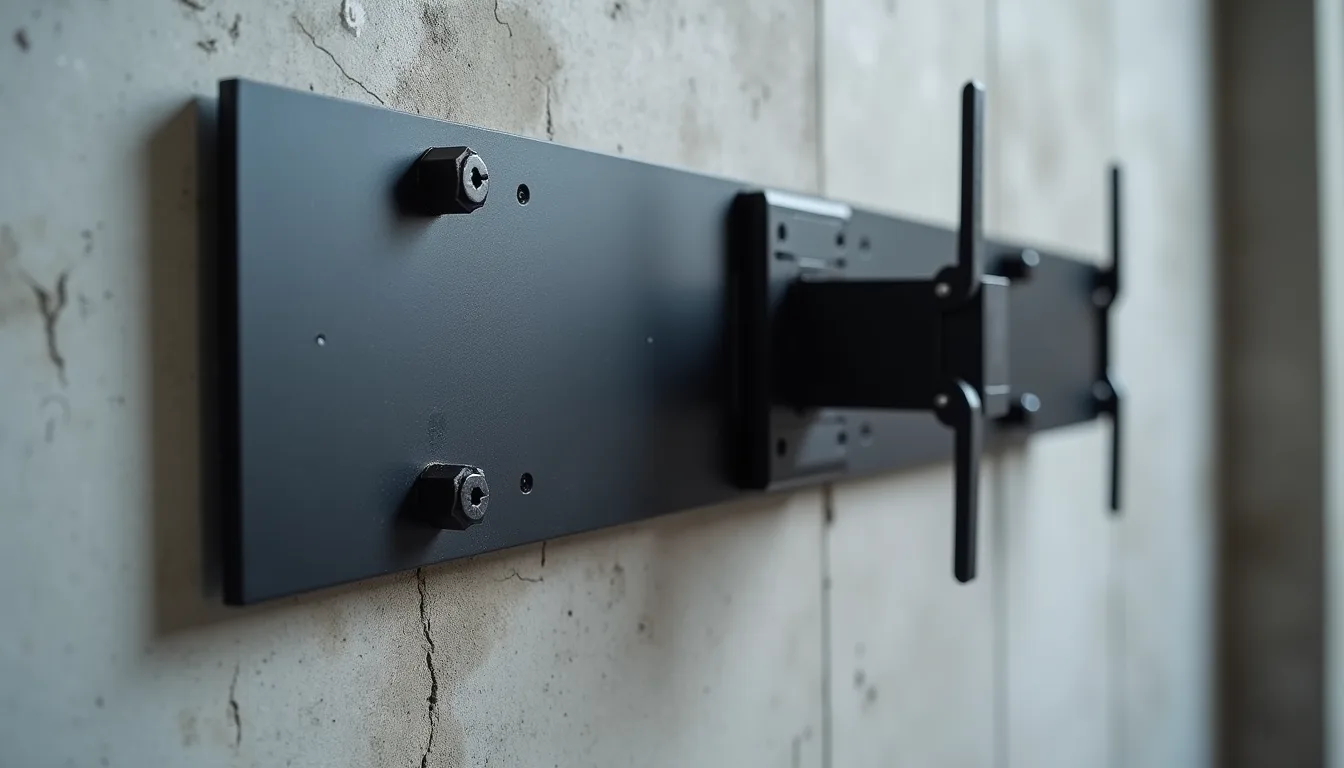
Fire-rated construction. Walls between tenancies, around exits, stairs and risers are often fire-rated, and putting a cable through one is not a matter of drilling a hole. The National Construction Code sets out how a penetration must be treated so the wall keeps its rating, in its specification on penetration of walls, floors and ceilings by services. Not every wall in your building is rated. The point is that some are, and finding out which is a question for the building manager or the plans before anyone picks up a drill.
Steel stud. Common in fit-outs and it behaves nothing like timber. The stud is thin folded steel, so the fixing has to suit it, and a bracket that would happily hang off two timber studs needs a different approach entirely. Where the load is significant we would rather fix to structure or add backing than trust a stud alone, for the reasons we go through in what actually holds a TV on plasterboard.
Concrete and blockwork. Straightforward to fix into and unforgiving about mistakes, since a hole in the wrong place is permanent. It also means surface conduit or a chased route for cable, because there is no cavity to hide in.
Everything else in there. Sprinkler pipework, conduit, data, gas and structural steel. In a tenancy you did not build, assume nothing and check before drilling.
Height and sightlines in a room full of people
At home, screen height is set from a seated eye line, and our guide to TV mounting height works through that. A venue reverses the logic, because the person nearest the screen is standing and the person paying for a meal is sitting down behind them.
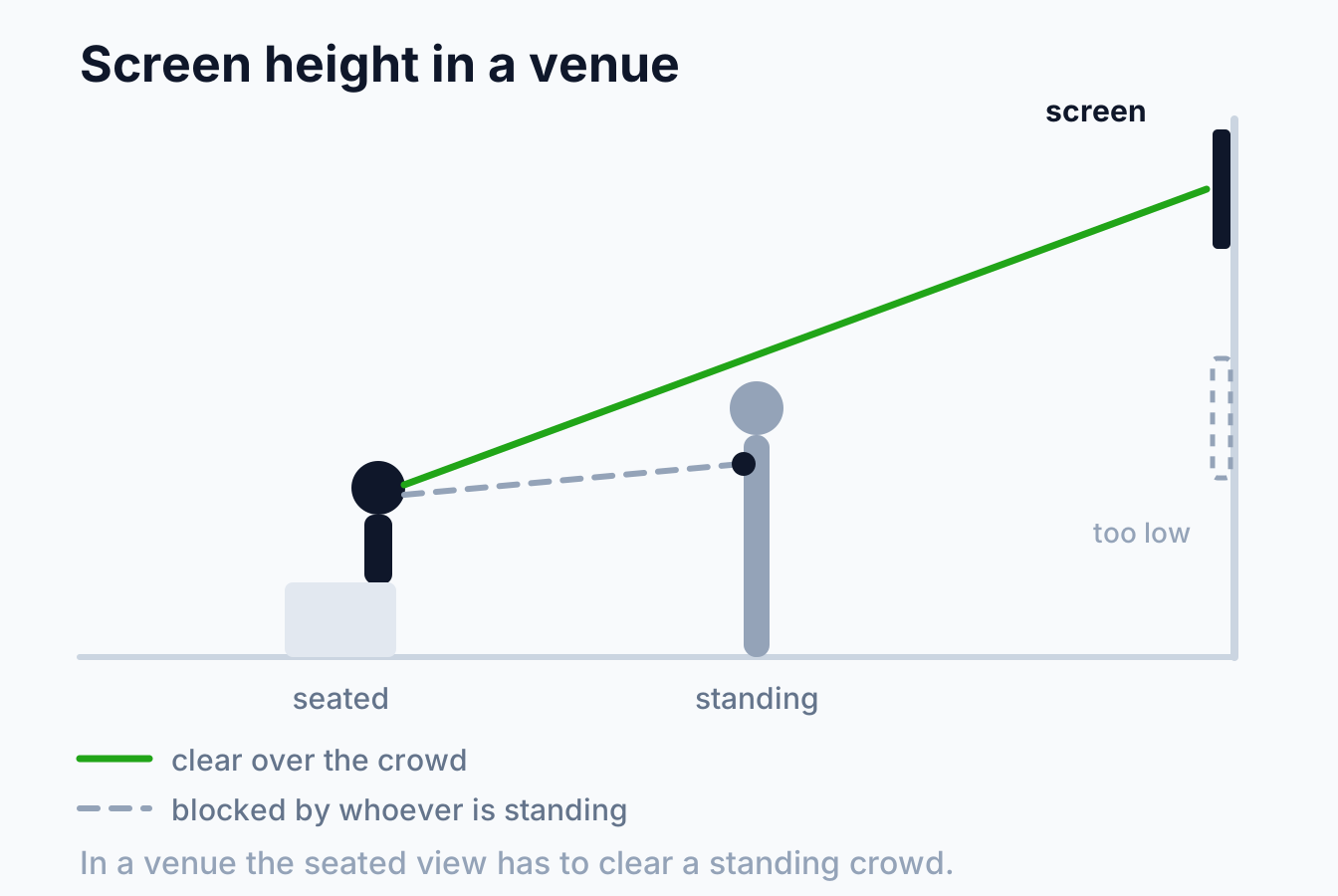
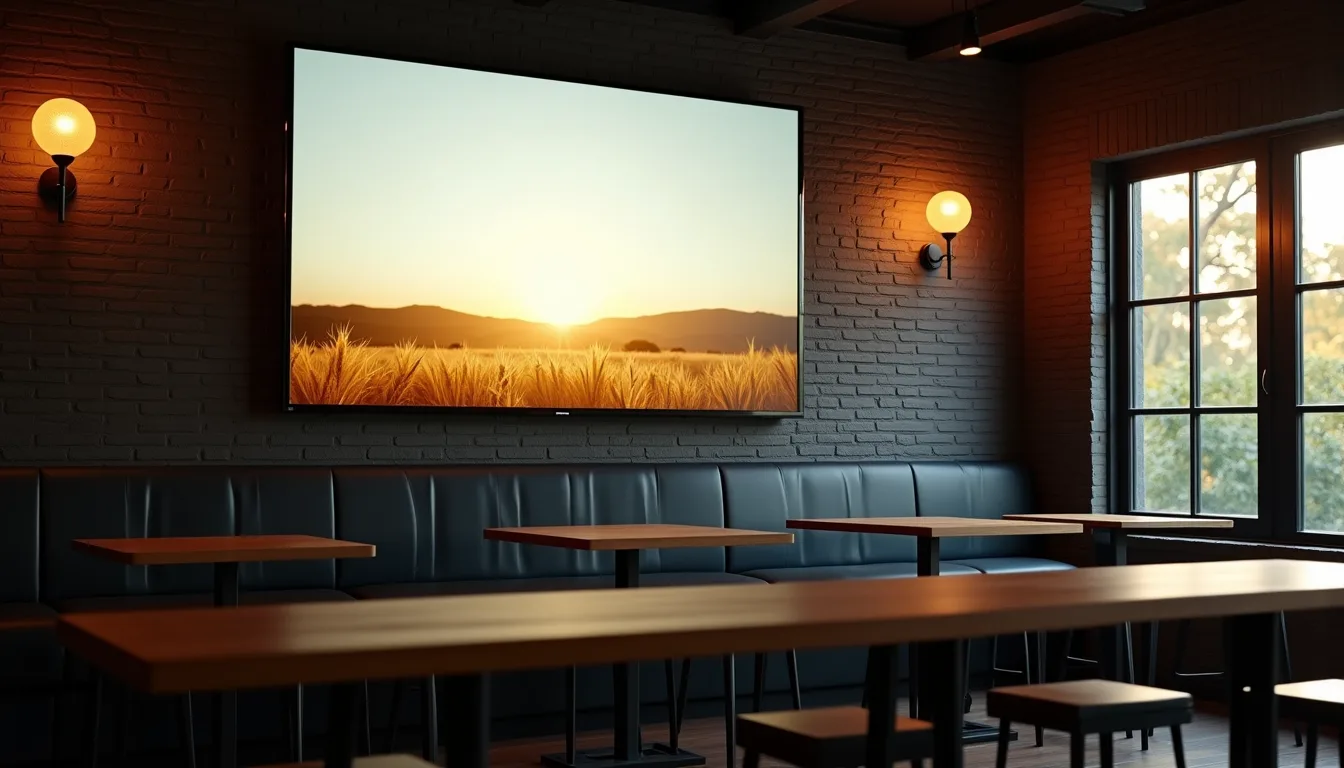
So the screen goes higher than it would at home, and how much higher depends on where people actually stand: at the bar, in a queue, along a walkway. The compromise to avoid is the middle position, high enough to be uncomfortable for the seated view and still low enough to be blocked when the room fills up.
Two other things follow from a public room. Anything within reach gets touched, so the fixings and the bracket have to assume that rather than hope otherwise, and a screen people walk past should sit flat against the wall rather than on an articulated arm someone will swing into a doorway. Our comparison of fixed, tilt and full-motion brackets applies, with the answer weighted much further towards fixed than it would be at home.
The last one is light. Shopfronts and glazed offices produce reflections a domestic lounge never has, and no amount of brightness fixes a window reflected in the middle of the screen. Sometimes the fix is the mounting angle. Sometimes it is a different wall.
Power, cabling and long runs
The rules that apply at home apply here, with more of them.
A new outlet behind a screen is electrical work, and Energy Safe Victoria is clear that this is not something to do yourself. Fixed cabling has its own requirement: the ACMA states that "To work as a cabler in Australia, you must be registered." On a commercial site both of those tend to matter more, because someone will eventually ask to see the paperwork.
The genuinely commercial problem is distance. A source in a comms room and a screen forty metres away is beyond what an HDMI cable will do on its own, so the signal goes over structured cabling with extenders at each end, or over the network. That decision is worth making before the ceiling closes, not after, and it is the single most common reason we get called back to a fit-out.
Concealment follows the same principles as a house, just with more of the work in ceilings and conduit than in wall cavities. Our guide to hiding cables behind a wall-mounted screen covers the residential version.
Working around a business that is trading
This is usually the part that decides who gets the job, and it is fair enough.
We work before opening and after close where the site needs it, and quote it that way rather than discovering it on the day. We carry public liability insurance and will send the certificate of currency before we attend, because most venues and every managed building will ask. Where a building requires an induction or a permit to work, that gets arranged in advance.
The practical things matter as much as the paperwork. Drop sheets down, dust controlled, and the area left clean enough to serve customers in. Ladders and cabling kept out of egress paths while we are there. And if something cannot be finished in the window we were given, the site gets left safe and tidy rather than half-done with a screen resting on a bar.
What we need to know to quote you
You can answer most of this from where you are sitting, and it turns a vague enquiry into a real number.
- How many screens, and roughly what size.
- What the walls are made of, if you know, and whether the tenancy is yours.
- Whether the screens are already bought, and what they are.
- Where the source equipment will live, and how far that is from each screen.
- What is at each screen position now: power, data, an antenna point, nothing.
- Your trading hours, and when we would be able to work.
- Whether the building requires an induction, a permit, or after-hours access arrangements.
If you have plans for the fit-out, those answer most of it at once. If you do not, we will come and look.
Frequently asked questions
Can I just use a normal TV in my cafe?
You can, and plenty do. Understand that it is very likely outside the manufacturer's warranty from day one, and that a panel running twelve hours a day is doing several times the work it was designed for. For light use it is a reasonable saving. For open to close it is a false one.
Do you work outside trading hours?
Yes, and for most hospitality and retail sites that is the default rather than the exception. It is quoted as part of the job rather than added afterwards.
Can you mount screens in portrait for menus or signage?
Yes, with a display rated for it. We would not turn a consumer television on its side, because the ventilation is designed for landscape and the heat has nowhere to go.
What about a screen outside, in a beer garden or under a verandah?
That is a different specification again, because weather, insects and temperature all get a say. Our guide to installing a TV outdoors covers what actually survives it.
Can you handle multiple screens across a site?
Yes, including feeding several screens from one source and matching what each one shows. That is where the cabling design does the work rather than the brackets, and it is worth planning as one system rather than as five separate installs.
Commercial work is mostly a planning problem wearing a tradesman's clothes. Get the display specification, the wall, the height and the cable route right and the install itself is straightforward. We do commercial TV wall mounting and AV across Melbourne and the Mornington Peninsula, for offices, cafes, restaurants, clubs, gyms, showrooms and schools, and you can see how our work finishes up on our projects page. Have a look at our TV wall mounting service, or get a quote and tell us what the site is.