It is the question we get asked most often before a quote: can I just buy an indoor antenna and save myself the trouble? Sometimes you can. Most of the time in Melbourne you cannot, and the reason has less to do with the antenna than with where you live and what your house is made of. Here is how the two compare, and how to work out which side of the line your place falls on.
The short version
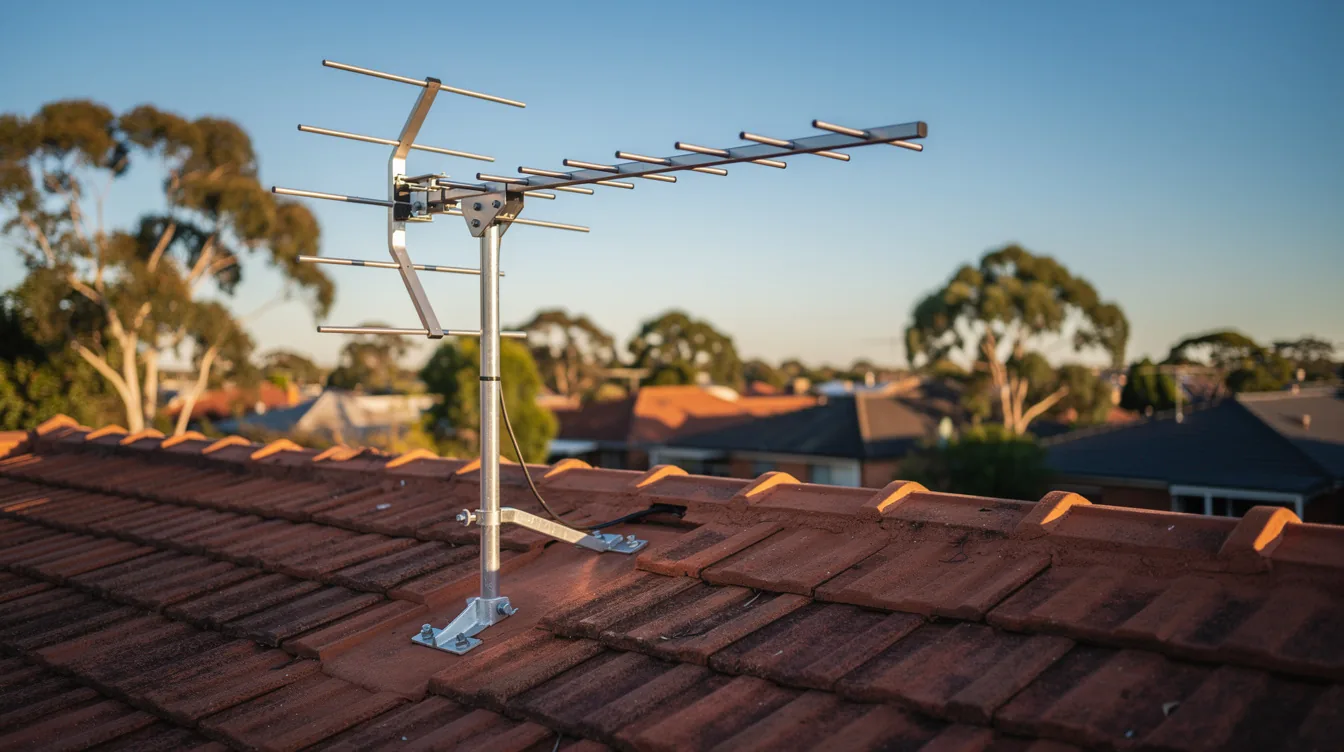
An outdoor antenna will outperform an indoor one in almost every Melbourne home. Height, size and a clear path to the transmitter determine reception, and an indoor antenna is compromised on all three by definition. Indoor antennas make sense in a narrow set of cases: close to the transmitter, a clear aspect in roughly the right direction, and a roof you cannot access. Outside those, an indoor antenna is usually money spent twice.
| Indoor | Outdoor | |
|---|---|---|
| Typical height | About a metre, inside the building | Above the roofline |
| VHF performance | Poor. Too small for the wavelength | Built for it |
| Blocked by sarking, low-e glass, brick | Yes, heavily | No |
| Beyond about 20km from the transmitter | Unreliable | Normal working range |
| Holds up in bad weather | Marginal setups drop out | Stable when installed properly |
| Installation | Five minutes, yourself | Professional, on the roof |
Why your roof beats your lounge room
Height
Signal travels line-of-sight. Every metre of height clears more of what sits between you and the transmitter. The neighbour's roof, a stand of gums, the rise of the land. An antenna on your media unit starts a metre off the floor with the whole house in the way.
Your house is in the path
This is the part most people underestimate. Building materials absorb and reflect television signal, and modern Australian construction is worse for it than older housing.
- Brick and concrete attenuate signal significantly, and a double-brick wall does it twice.
- Foil-backed sarking and insulation, standard in newer builds and re-roofs, is essentially a metal sheet wrapped around your house. Very good at its job, and very good at blocking radio signal.
- Low-emissivity glazing, the energy-efficient glass now common in new builds and renovations, carries what the Australian Government's YourHome guide describes as a thin film metal coating. It reflects heat, and it reflects signal too.
- Metal roofing and wall cladding for the same reason.
A house built to a modern energy rating is, from a radio point of view, a partial Faraday cage. Good for your heating bill, inconvenient for an antenna sitting inside it.
Size, and why it matters more in Melbourne
An antenna needs to be physically large relative to the wavelength it receives. Australian television sits in two bands: VHF channels 6 to 12, from 174 to 230MHz, and UHF channels 27 to 51, from 520 to 694MHz, per the ACMA band plan.
At the VHF end that is a wavelength close to 1.7 metres, which is why a rooftop antenna carries those long elements at one end. UHF wavelengths are nearer half a metre, so a UHF section can be far more compact, which is why a small indoor unit can make a reasonable fist of UHF and almost nothing of VHF.
Here is the local sting. Melbourne's main free-to-air services all transmit on VHF from Mount Dandenong, not UHF. The band an indoor antenna handles worst carries the channels you actually want, which is why the usual complaint is not a blank screen but a short channel list: a few services scanned in and the main networks missing or breaking up. For more on antenna types, see our guide to choosing a TV antenna in Melbourne.
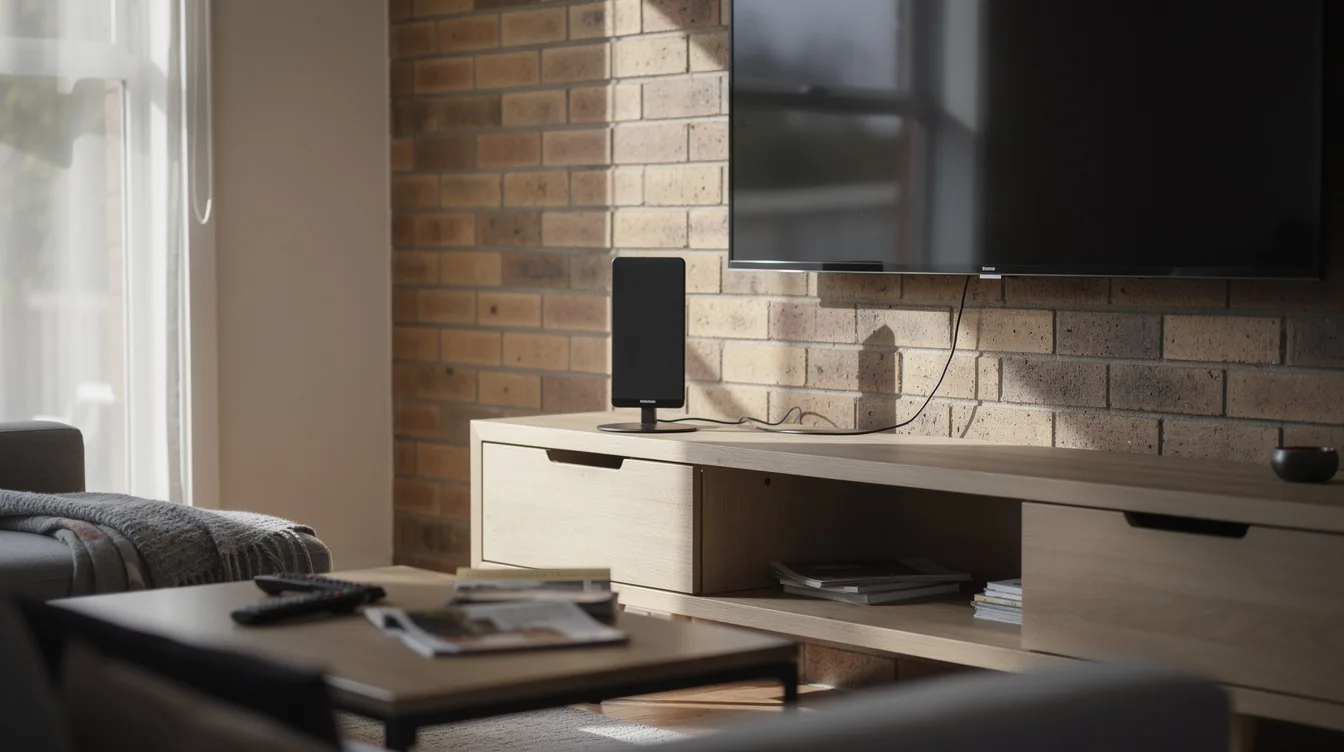
When an indoor antenna genuinely works
We are not going to tell you it never does. It works when the conditions are right, and they are specific.
- You are close to the transmitter. Inner-suburban homes within roughly 20km of Mount Dandenong have strong enough signal for an indoor antenna to work with.
- You have a window facing the right way. On a windowsill pointing towards the transmitter, with nothing large outside it, an indoor antenna does far better than on a shelf against an internal wall.
- You are in an apartment with no roof access, though see below, because it may not be the only option you think it is.
- You are renting and cannot install anything. A legitimate constraint, and a reasonable compromise.
- It is a second set. A bedroom or caravan TV, where a drop-out is an annoyance rather than a problem.
Most of those are constraints rather than preferences. When someone chooses an indoor antenna freely, it is usually because they have underestimated the house.
The amplified indoor antenna trap
Almost every indoor antenna on the shelf is sold as "amplified", and people reasonably assume that solves the problem. It does not.
An amplifier boosts everything reaching it. The signal you want and the noise alongside it, in the same proportion. If the signal has already come through a brick wall and some foil sarking, amplifying it gives you a stronger weak, noisy signal. The ratio between the two, which decides whether your tuner can decode a picture, has not improved at all.
Worse, in a strong-signal area an amplifier can overload the tuner and make things worse than none at all. Amplification overcomes cable loss and splits a good signal across outlets. It is not a substitute for a decent antenna in a decent position.
Apartments and units: the option people miss
If you are in an apartment and reception is poor, first establish whether the building already has a master antenna system: one rooftop antenna distributed to every apartment through an amplifier and a network of cabling. Most Melbourne apartment buildings do, and our guide to TV antennas in apartments and units covers how those systems work and whose job they are.
Where those systems are old, badly balanced, or have had outlets added without the distribution being reworked, individual apartments get poor reception even though the roof antenna is fine. It looks like a problem in your unit; it is a problem in the building. The fix is at the distribution end, it is a body corporate matter, and no indoor antenna will address it, worth finding out before you spend money on hardware. We go through that in our guide to antennas in apartments and units.
What it actually costs you either way
An indoor antenna is cheaper up front and takes five minutes to install yourself. That is the whole of its advantage, and for some households it is enough. Our guide to what antenna work costs in Melbourne sets out the other side of that comparison. What to weigh is the cost of it not working: the pattern we see is someone buying an indoor antenna, getting a partial channel list, buying a second and dearer one, and calling us anyway. Two antennas they cannot use, plus the installation they were trying to avoid.
Within about 20km of the transmitter with a clear aspect, an indoor antenna is worth a try. Further out, in a newer or well-insulated house, or in a street you already know is patchy, trying one first is usually the more expensive path.
How to tell without guessing
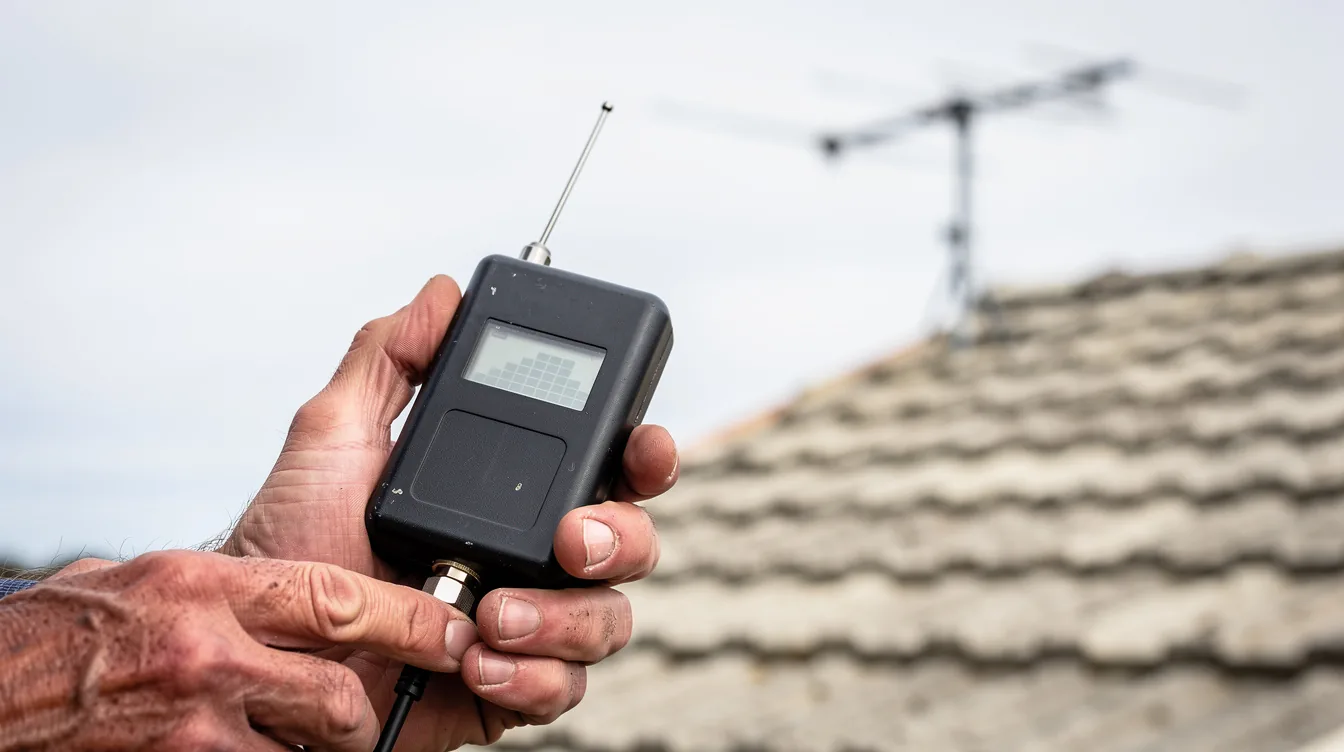
Reception varies street to street and sometimes house to house. A ridge line behind one property, or a row of mature gums along a fence, can make two neighbours' experiences entirely different, which is why we take a reading rather than estimate from a map.
A signal meter reads both strength and quality, and the two are not the same. A strong signal with poor quality still pixelates, and that distinction tells us whether the answer is a different antenna, a better position, or a repair. It takes a few minutes and it is part of the free onsite quote.
Rule out the obvious first, too. The ACMA's guidance on TV reception problems and fixes notes that antennas generally last only 10 to 15 years, and that old or disconnected antennas and indoor "rabbit ears" left in the system are a common cause of trouble. If there is already an antenna on your roof, its age and condition matter more than anything you could buy to sit beside the TV.
Frequently asked questions
Will an indoor antenna work in an older brick house?
Sometimes, and usually better than in a comparable new build: older homes typically lack foil sarking and low-e glazing, the two materials that hurt indoor reception most. Solid brick still attenuates signal, so position near a window on the transmitter side.
Is a more expensive indoor antenna worth it?
Rarely. Above a modest price point you are mostly paying for styling and an amplifier, neither of which addresses the limits of being indoors. If a cheap indoor antenna does not work at your place, an expensive one usually will not either.
Can I put an "indoor" antenna in the roof cavity?
Better than the lounge room, since you have cleared the ceiling and gained height. It is still below the roofing material, and with foil sarking or a metal roof you have simply moved the antenna to the wrong side of the barrier. It works in some houses, not at all in others.
What about reception in bad weather?
Heavy rain attenuates signal slightly, and an already marginal installation can tip over the edge in a downpour. If your picture drops out whenever it rains, that usually points to a marginal setup or water in a connection rather than the weather itself, and our guide to TV reception problems runs through the causes.
We install and repair antennas across Melbourne and the Mornington Peninsula, and we will tell you honestly if the one you have is fine. If you would rather know than guess, see TV antenna installation.